
Insights
Pricing Is a Product Problem, Not a Finance Problem
April 28, 2026 · Ameet Kulkarni
Last week at AI Week Atlanta, I was in a room full of builders, enthusiasts, and product leaders buzzing about what AI could do. Agents, governance, security, new products — great energy. Nobody brought up pricing. Which, honestly, tracks. Monetization is a bit of a buzzkill when you’re excited about the future.
The few pricing conversations I did have were telling. Early-stage founders who’d picked a number that felt right, no real structure behind it — understandable when you’re pricing to survive. One established vendor giving channel discounts well above industry norms with no clear path to unwind them. In both cases, the realization was the same: the right pricing could move the top line meaningfully, but the system around it was where the real work lived.
I’ve been in the messy middle of it a few times. At Cisco, I led ISE’s monetization transformation. The price change was one part of the story. The harder part was building everything underneath it.
Pricing isn’t just about what to charge. Treating it as a system, one that touches product, engineering, finance, sales, and customer experience, is what makes the difference. Overlook any one and the whole exercise gets messier than it needs to be. Let me walk through what I’ve seen in practice.
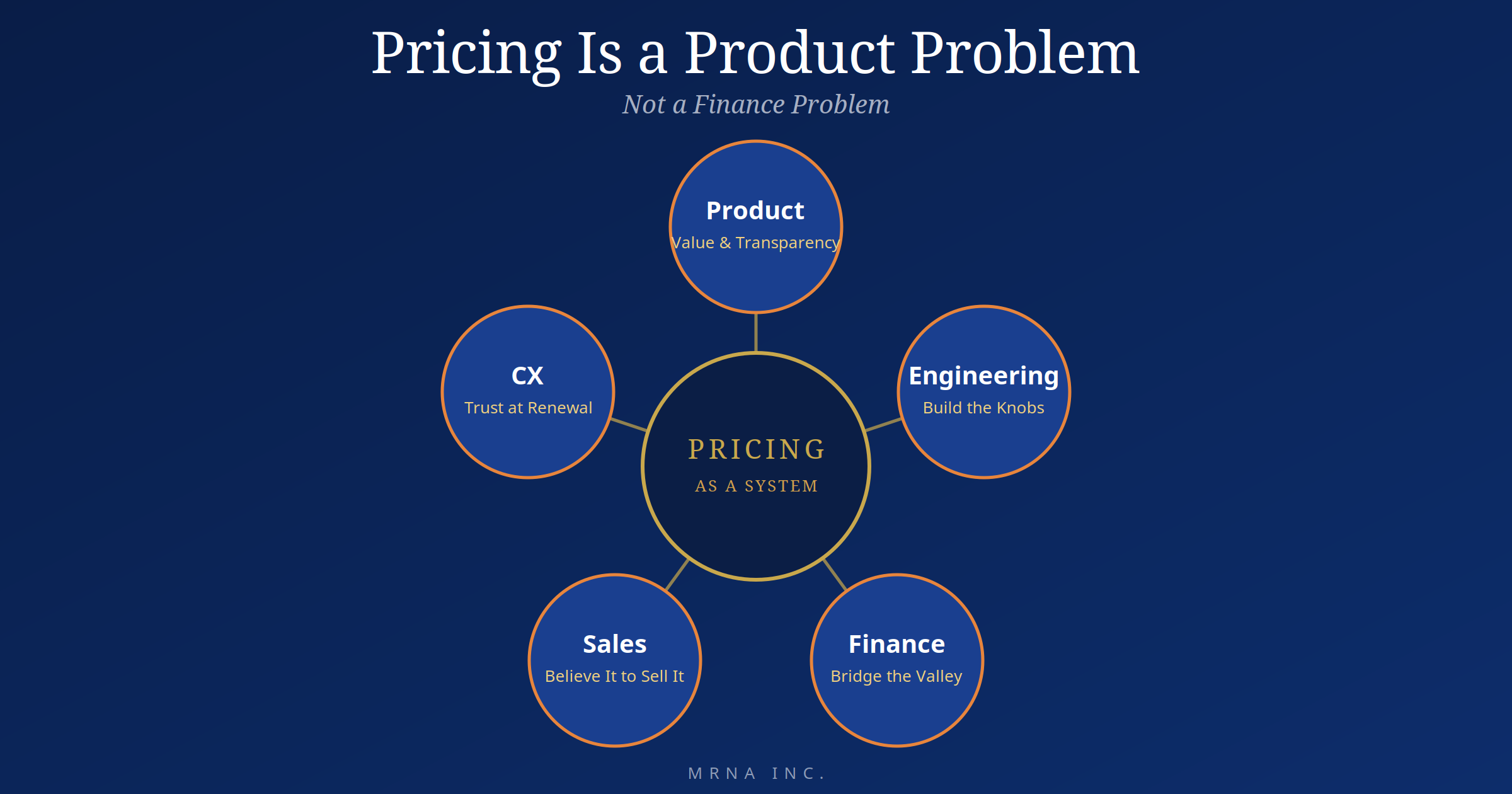
Product: The meter has to match the value, and you have to prove it.
Identifying how customers value your product and how much to charge is table stakes. But you also have to figure out how to track usage and provide that transparency back to customers. At ISE, we moved from an old perpetual and subscription mixture software licensing to better tiered full subscription packaging. Base had been perpetual while Plus and Apex were subscription, and the way features were defined in each license category had gone through a lot of change over time. It needed a rethink. The packaging change was just the headline. The real work was building the usage tracking, the dashboards customers could see, and the audit trails that proved the numbers were right.
Because if your customer can’t see their usage, they don’t trust the bill. And if they don’t trust the bill, they fight every renewal. Pricing without transparency is just a guessing game that your customer isn’t playing.
Engineering: Somebody has to build the knobs.
This is the part nobody in the pricing meeting thinks about. You can design the most elegant pricing model on a whiteboard, but if the engineering team hasn’t built the telemetry, the metering hooks, the usage aggregation, and the billing integration, it doesn’t exist. At ISE, we rebuilt the licensing infrastructure before we changed a single price. The architecture had to come first.
And it’s not just “build it and we’re done.” The knobs have to be tuned. Usage counters need to match what the bill says. Provisioning timing has to align with billing cycles. Edge cases like trials, grace periods, overages, downgrades. Each one is a product and engineering decision that has to be built, tested, and verified. Miss one and you’ve got customers seeing a different number than finance does. That’s not a discrepancy. That’s a trust problem.
Want to know how many edge cases exist in a pricing migration? More than your worst guess. Multiply by three. You’re still low.
Finance: The bridge period is the dangerous part.
There will be a period during migration when your customer base is split, some on the old model, some on the new. Finance needs to understand this transition, how long the overlap will exist, and what it means for the product’s financials. They’re not wrong to worry. There’s real downside exposure: customers accelerating to the cheaper model, revenue recognition complexity, channel conflict on pricing quotes.
But finance teams also want to know: what’s the extent of the downside, and when does the trend reverse? Every transition I’ve been in, we modeled the “valley,” the period where old-model attrition outpaces new-model growth, and gave finance a date when the line crosses. That’s what they needed. Not a promise that everything would be fine. A curve with a crossover point they could plan around.
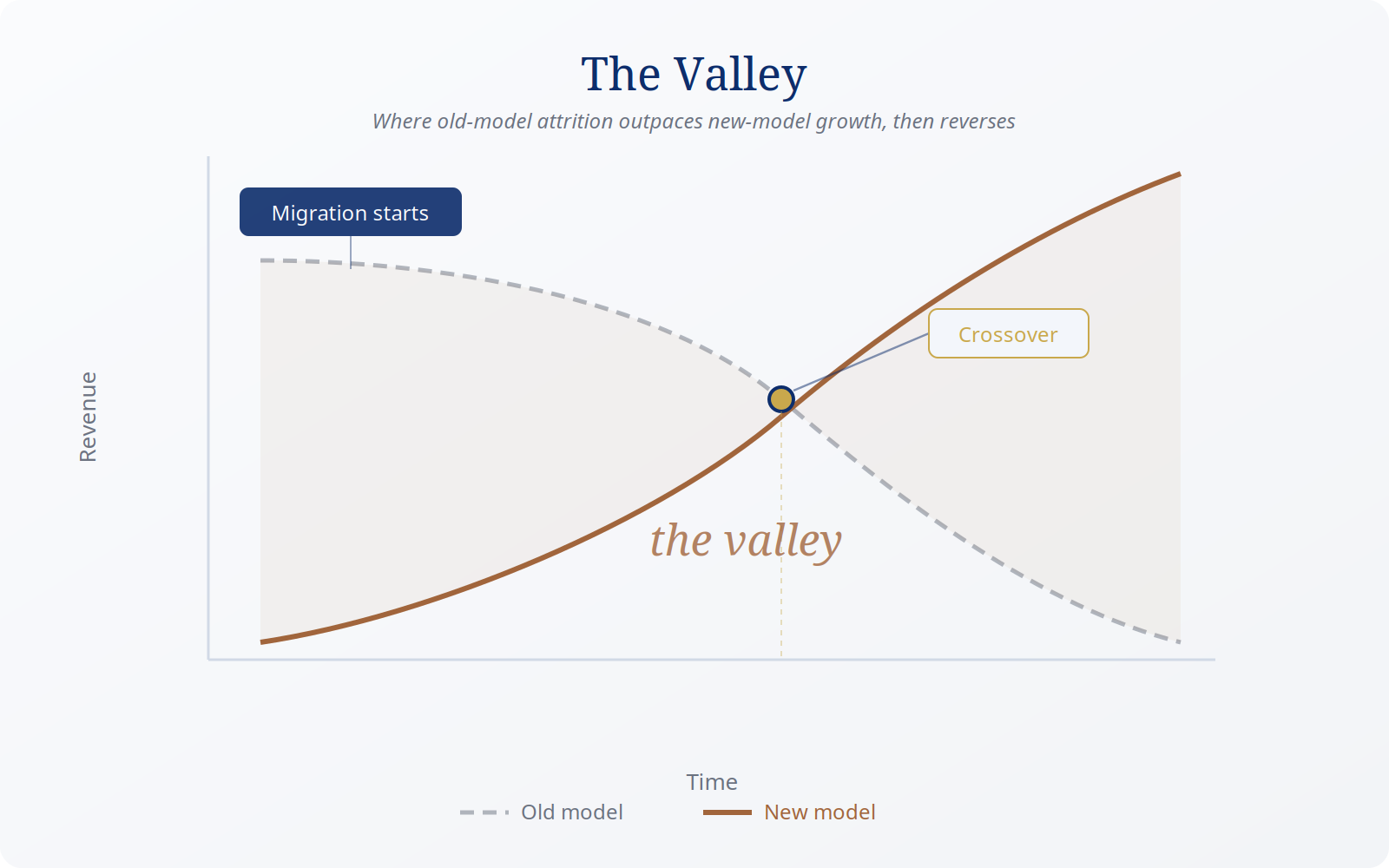
The answer to “is this financially sound?” isn’t yes or no. It’s “here’s the timeline, here’s the exposure, here’s when it reverses.”
Sales: They need to believe it before they can sell it.
Sales teams have the hardest job in a pricing transformation. They’re the ones standing in front of the customer explaining why the new structure makes sense. Handling objections like “why am I paying more for the same thing?” and competitive pressure like “your competitor charges less.”
Before we made the ISE changes, we brought sales leadership and key reps into the loop early. We discussed our proposals with them, took in their feedback. That saved a lot of challenges later. After launch, I was on multiple calls with the sales team, hearing the objections in real time, refining the messaging, and building a playbook that addressed the actual questions customers asked, not the ones we thought they’d ask.
A good way to test your proposal: if your sales team can’t explain the pricing to a skeptical buyer in about 90 seconds, it probably needs more work before launch.
Customer Experience: Renewals are where trust gets tested.
The customer experience teams that handle renewals will need to ensure their workflows account for the new monetization approach and guide existing customers through it. These teams hear the frustration first. The customer who was on a great deal under the old model and now feels like they’re paying more. Or the one who can’t reconcile their bill with what they think they’re using. At ISE, we had customers on perpetual deals who would face subscription licenses. CX needed scripts for “why am I paying annually when I bought once?” and escalation paths for when the rep couldn’t explain the value shift. Renewal conversations under a new pricing model are not business-as-usual. They require updated scripts, updated training, and a clear escalation path when a customer pushes back on something the CX rep can’t explain.
Running two models or cutting over?
One strategic decision you’ll face early: do you run two monetization models simultaneously, or do a hard cutover at a specific timeline? At ISE, we ran both for some time and then cut over to the new model. We timed the introduction of the new model with a new software version, which made it easier to ensure quick cutover to the new model in the buying platform. That was a deliberate strategic decision, not an accident of timing.
There’s no universal right answer. It depends on your installed base, your billing platform, and your risk tolerance. But whatever you choose, every org needs to understand the plan. If two models are live simultaneously, your billing platform must handle both with no reconciliation errors, and every team needs to know how to handle a customer on either one and how to talk about the transition roadmap.
AI-native companies are starting to build this in. They launch with usage-based and seat-based models coexisting because their product serves developers (who want metered API access) and buyers (who want per-seat predictability) or are addressing the consumer as well as enterprise market. The lesson isn’t that you need two models. It’s that if you’re going to run two, every part of your org needs to know and be prepared.
So what?
If you’re adding AI features to a B2B product and trying to figure out how to monetize them, the pricing model and the price are one part of the exercise. The system around it, the usage tracking, the engineering infrastructure, the financial bridge model, the sales enablement, the CX workflow, is where it all comes together.
At ISE, the monetization transformation grew annual bookings to $350M+. The price change was important. But the system, the architecture, the transparency, the cross-functional coordination, was what made it stick.
That’s the work I do now — helping B2B teams build the system that makes pricing stick, not just pick a number.
Ameet Kulkarni is the founder of MRNA Inc., a product strategy consultancy for B2B companies at inflection points. He led the monetization transformation of Cisco ISE from perpetual to subscription, growing annual bookings to $350M+.